Logo image

Section 8.3 Caesar Ciphers

One of the earliest known approaches to symmetric key cryptography was applied by Julius Caesar (100 BC to 44 BC) and is now called the Caesar cipher. In a Caesar cipher we cyclically shift the alphabet by \(n\) letters, where \(n\) is a natural number. For encryption we shift \(n\) characters backwards and wrap around to \(\mathtt{z}\) after \(\cspace\text{.}\) To undo this we shift \(n\) characters forward and wrap around to \(\cspace\) after \(\mathtt{z}\text{.}\)
Caesar did not encrypt the space character, and most other authors follow that convention. Our version of Caesar ciphers is different. Instead of shifting only the letters of the alphabet, we shift our set of characters. This set contains the 26 letters and the space character, which we represent by \(\cspace\text{.}\)
In our first examples we consider the case \(n=3\text{.}\)

Example 8.3.1. Encrypting Caesar cipher shifting by \(3\) characters.

Alice and Bob use the Caesar cipher shifts by \(3\) characters for their communication.
Suppose Alice wants to encrypt \(\mathtt{hat}\) and send the resulting encrypted message to Bob. She continues as follows.
To encrypt \(\mathtt{h}\) Alice counts three characters backwards from \(\mathtt{h}\text{.}\) One character before \(\mathtt{h}\) is \(\mathtt{g}\text{.}\) Two characters before \(\mathtt{h}\) is \(\mathtt{f}\text{.}\) Three characters before \(\mathtt{h}\) is \(\mathtt{e}\text{.}\) So \(\mathtt{h}\) is encrypted as \(\mathtt{e}\text{.}\)
To encrypt \(\mathtt{a}\) Alice counts three characters backwards from \(\mathtt{a}\text{.}\) One character before \(\mathtt{a}\) is \(\cspace\text{.}\) Now we wrap around to \(\mathtt{z}\) which means that two characters before \(\mathtt{a}\) we have \(\mathtt{z}\text{.}\) So three characters before \(\mathtt{a}\) is \(\mathtt{y}\text{.}\) So \(\mathtt{a}\) is encrypted as \(\mathtt{y}\text{.}\)
To encrypt \(\mathtt{t}\) Alice counts three characters backwards from \(\mathtt{t}\text{.}\) One character before \(\mathtt{t}\) is \(\mathtt{s}\text{.}\) Two characters before \(\mathtt{t}\) is \(\mathtt{r}\text{.}\) Three characters before \(\mathtt{t}\) is \(\mathtt{q}\text{.}\) So \(\mathtt{t}\) is encrypted as \(\mathtt{q}\text{.}\)
So Alice encrypts \(\mathtt{hat}\) as \(\mathtt{eyq}\) and thus sends \(\mathtt{eyq}\) to Bob.

Example 8.3.2. Decrypting Caesar cipher shifting by \(3\) characters.

Alice and Bob use the Caesar cipher shifts by \(3\) characters for their communication.
Bob receives the message \(\mathtt{eyq}\) from Alice. To decrypt the message he continues as follows.
To decrypt \(\mathtt{e}\) Bob counts three characters forward from \(\mathtt{h}\text{.}\) One character after \(\mathtt{e}\) we have \(\mathtt{f}\text{.}\) Two characters after \(\mathtt{e}\) is \(\mathtt{g}\text{.}\) Three characters after \(\mathtt{e}\) is \(\mathtt{h}\text{.}\) So \(\mathtt{e}\) is decrypted to \(\mathtt{h}\text{.}\)
To decrypt \(\mathtt{y}\) Bob counts three characters forward from \(\mathtt{y}\text{.}\) One character after \(\mathtt{y}\) we have \(\mathtt{z}\text{.}\) Now we wrap around to \(\cspace\) which means that two characters after \(\mathtt{y}\) we have \(\cspace\text{.}\) Three characters after \(\mathtt{y}\) is \(\mathtt{a}\text{.}\) So \(\mathtt{y}\) is decrypted to \(\mathtt{a}\text{.}\)
To decrypt \(\mathtt{q}\) Bob counts three characters forward from \(\mathtt{q}\text{.}\) One character after \(\mathtt{q}\) we have \(\mathtt{r}\text{.}\) Two characters after \(\mathtt{q}\) is \(\mathtt{s}\text{.}\) Three characters after \(\mathtt{q}\) is \(\mathtt{t}\text{.}\) So \(\mathtt{q}\) is decrypted to \(\mathtt{t}\text{.}\)
So Bob find that the decrypted message is \(\mathtt{hat}\text{.}\)
Decrypting text that was encrypted with a Caesar cipher is easier than encrypting it. When we decrypt, we count forward in the alphabet. Most of us are better at moving forward in the alphabet than backward.
We give another example for decrypting a message that was encrypted with a Caesar cipher.

Problem 8.3.3. Caesar cipher shifting by two characters.

Decrypt the cipher text
\begin{equation*} \mathtt{zlbywmsy{\cspace}psrsq} \end{equation*}
that was encrypted with the Caesar cipher that shifts by 2 characters.
Solution.
To decrypt we count forward \(2\) characters, that is, \(\mathtt{a}\) is decrypted to \(\mathtt{c}\text{,}\) \(\mathtt{b}\) is decrypted to \(\mathtt{d}\text{,}\) and so on. When we get to \(\mathtt{z}\) we wrap around to \(\cspace\) which is followed by \(\mathtt{a}\text{.}\) Thus \(\mathtt{z}\) is decrypted to \(\mathtt{a}\text{.}\) For the characters in the cipher test we get:
\(\mathtt{z}\) is decrypted to \(\mathtt{a}\)
\(\mathtt{l}\) is decrypted to \(\mathtt{n}\)
\(\mathtt{b}\) is decrypted to \(\mathtt{d}\)
\(\mathtt{y}\) is decrypted to \(\cspace\)
\(\mathtt{w}\) is decrypted to \(\mathtt{y}\)
\(\mathtt{m}\) is decrypted to \(\mathtt{o}\)
\(\mathtt{s}\) is decrypted to \(\mathtt{u}\)
\(\cspace\) is decrypted to \(\mathtt{b}\)
\(\mathtt{p}\) is decrypted to \(\mathtt{r}\)
\(\mathtt{r}\) is decrypted to \(\mathtt{t}\)
\(\mathtt{q}\) is decrypted to \(\mathtt{s}\)
So the cipher text \(\mathtt{zlbywmsy}{\cspace}\mathtt{psrsq}\) is decrypted to \(\mathtt{and}{\cspace}\mathtt{you}{\cspace}\mathtt{brutus}\text{.}\)
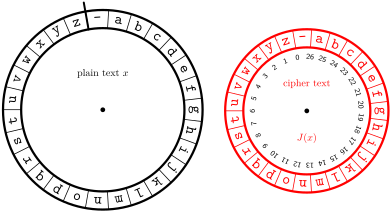
There are several ways of representing and evaluating the decryption and encryption functions of a Caesar cipher. In the following examples we use encryption and decryption functions given by table and a decoder disc. The decoder disc is more compact and shows better how the characters wrap around.
\(x\) \(J(x)\)
\(\cspace\) \(\mathtt{x}\)
\(\mathtt{a}\) \(\mathtt{y}\)
\(\mathtt{b}\) \(\mathtt{z}\)
\(\mathtt{c}\) \(\cspace\)
\(\mathtt{d}\) \(\mathtt{a}\)
\(\mathtt{e}\) \(\mathtt{b}\)
\(\mathtt{f}\) \(\mathtt{c}\)
\(\mathtt{g}\) \(\mathtt{d}\)
\(\mathtt{h}\) \(\mathtt{e}\)
\(\mathtt{i}\) \(\mathtt{f}\)
\(\mathtt{j}\) \(\mathtt{g}\)
\(\mathtt{k}\) \(\mathtt{h}\)
\(\mathtt{l}\) \(\mathtt{i}\)
\(\mathtt{m}\) \(\mathtt{j}\)
\(\mathtt{n}\) \(\mathtt{k}\)
\(\mathtt{o}\) \(\mathtt{l}\)
\(\mathtt{p}\) \(\mathtt{m}\)
\(\mathtt{q}\) \(\mathtt{n}\)
\(\mathtt{r}\) \(\mathtt{o}\)
\(\mathtt{s}\) \(\mathtt{p}\)
\(\mathtt{t}\) \(\mathtt{q}\)
\(\mathtt{u}\) \(\mathtt{r}\)
\(\mathtt{v}\) \(\mathtt{s}\)
\(\mathtt{w}\) \(\mathtt{t}\)
\(\mathtt{x}\) \(\mathtt{u}\)
\(\mathtt{y}\) \(\mathtt{v}\)
\(\mathtt{z}\) \(\mathtt{w}\)
(a) Encryption function \(J:\A\to\A\)
\(y\) \(J^{-1}(y)\)
\(\cspace\) \(\mathtt{c}\)
\(\mathtt{a}\) \(\mathtt{d}\)
\(\mathtt{b}\) \(\mathtt{e}\)
\(\mathtt{c}\) \(\mathtt{f}\)
\(\mathtt{d}\) \(\mathtt{g}\)
\(\mathtt{e}\) \(\mathtt{h}\)
\(\mathtt{f}\) \(\mathtt{i}\)
\(\mathtt{g}\) \(\mathtt{j}\)
\(\mathtt{h}\) \(\mathtt{k}\)
\(\mathtt{i}\) \(\mathtt{l}\)
\(\mathtt{j}\) \(\mathtt{m}\)
\(\mathtt{k}\) \(\mathtt{n}\)
\(\mathtt{l}\) \(\mathtt{o}\)
\(\mathtt{m}\) \(\mathtt{p}\)
\(\mathtt{n}\) \(\mathtt{q}\)
\(\mathtt{o}\) \(\mathtt{r}\)
\(\mathtt{p}\) \(\mathtt{s}\)
\(\mathtt{q}\) \(\mathtt{t}\)
\(\mathtt{r}\) \(\mathtt{u}\)
\(\mathtt{s}\) \(\mathtt{v}\)
\(\mathtt{t}\) \(\mathtt{w}\)
\(\mathtt{u}\) \(\mathtt{x}\)
\(\mathtt{v}\) \(\mathtt{y}\)
\(\mathtt{w}\) \(\mathtt{z}\)
\(\mathtt{x}\) \(\cspace\)
\(\mathtt{y}\) \(\mathtt{a}\)
\(\mathtt{z}\) \(\mathtt{b}\)
(b) Decryption function \(J^{-1}:\A\to\A\)
Figure 8.3.4. Encryption \(J\) and decryption functions \(J^{-1}\) for the Caesar cipher that shifts by \(3\) characters. The table for the functions \(J^{-1}\) is obtained by reading the table for \(J\) from right to left.
For Caesar ciphers, it is often easier to view encryption as applying a function and decryption as applying the decryption function, especially for longer texts.

Example 8.3.5. Encryption with a function given by a table.

Alice and Bob use the Caesar cipher shifts by \(3\) characters for their communication.
Instead of counting characters backward as in Example 8.3.1, we can use the encryption function \(J:\A\to\A\) given in Figure 8.3.4.(a). To encrypt a character, find it in the left column. Its encrypted character is in the right column. For the characters in \(\mathtt{hat}\) we get
\begin{equation*} J(\mathtt{h})=\mathtt{e},\quad J(\mathtt{a})=\mathtt{y},\quad J(\mathtt{h})=\mathtt{q}\text{.} \end{equation*}
So \(\mathtt{hat}\) is encrypted as \(\mathtt{eyq}\text{.}\)

Example 8.3.6. Decrypting with a function given by a table.

Alice and Bob use the Caesar cipher shifts by \(3\) characters for their communication.
In the same way, instead of counting characters backwards as in Example 8.3.2 we can use the decryption function \(J^{-1}:\A\to\A\) given in Figure 8.3.4.(b). For the characters in \(\mathtt{eyq}\) we get
\begin{equation*} J(\mathtt{e})=\mathtt{h},\quad J(\mathtt{y})=\mathtt{a},\quad J(\mathtt{q})=\mathtt{t} \end{equation*}
So \(\mathtt{hat}\) is decrypted to \(\mathtt{hat}\text{.}\)
We once more use Figure 8.3.4.(a) to encrypt a message.

Problem 8.3.7.

Encrypt \(\mathtt{gaius-julius}\) using the Caesar cipher shifting by 3 characters.
Solution.
We apply the function \(J\) from Figure 8.3.4. This function can also be represented by the decoder disc in Example 8.3.8 with a shift by \(3\) characters. Avoiding duplication we get:
\begin{align*} J(\mathtt{g})\amp=\mathtt{d}\\ J(\mathtt{a})\amp=\mathtt{y}\\ J(\mathtt{i})\amp=\mathtt{f}\\ J(\mathtt{u})\amp=\mathtt{r}\\ J(\mathtt{s})\amp=\mathtt{p}\\ J(\cspace)\amp=\mathtt{x}\\ J(\mathtt{j})\amp=\mathtt{g}\\ J(\mathtt{l})\amp=\mathtt{i} \end{align*}
Thus \(\mathtt{gaius{\cspace}julius}\) is encrypted as \(\mathtt{dyfrpxgrifrp}\text{.}\)
The encryption and decryption functions \(J\) and \(J^{-1}\) can also be represented by decoder discs as applied in Example 8.3.8 and Example 8.3.9 respectively. To evaluate the encryption function \(J\) we read from the outer ring to the inner ring. To evaluate the decryption function we read from the inner ring to the outer ring.

Example 8.3.8. Encryption with a decoder disc interactive.

Example 8.3.9. Decryption with a decoder disc interactive.

We present the process of using decoder discs in the video in Figure 8.3.10.
Figure 8.3.10. Caesar Cipher with Decoder Disc by Matt Farmer and Stephen Steward
You can use the discs in Figure 8.3.11 to build an adjustable decoder disc for encrypting and decrypting any Caesar cipher.
Figure 8.3.11. Build your own decoder disc. Cut out the plain text disc on the left and the cipher text disc right. Punch a hole into the center of each disc. Put a split pin trough the center of both discs. To set the decoder disc up for the Caesar cipher that shifts by a natural number \(n\) align the number \(n\) on the inner disc with the line between \(\mathtt{z}\) and \(\cspace\text{.}\)

