Symmetric key cryptography is an application of functions. An encryption function turns readable plain text into unreadable cipher text, and the matching decryption function turns the cipher text back into the original plain text.
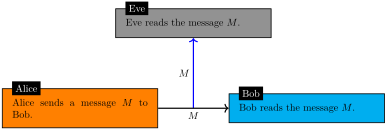
Cryptographic protocols are often described as interactions between Alice, Bob, and Eve. Alice sends a message to Bob. The eavesdropper Eve listens to their conversation and tries to break their encryption (Figure 8.2.1).
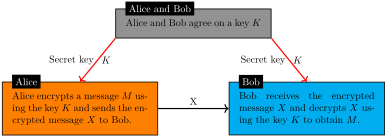
In a symmetric key encryption scheme, Alice and Bob first agree on a shared key. Alice uses the key to encrypt a message and sends the encrypted message to Bob. Bob then uses the same key to decrypt the message and recover its original form (Figure 8.2.2). The next two sections use Caesar ciphers and other substitution ciphers as examples of symmetric key encryption schemes.
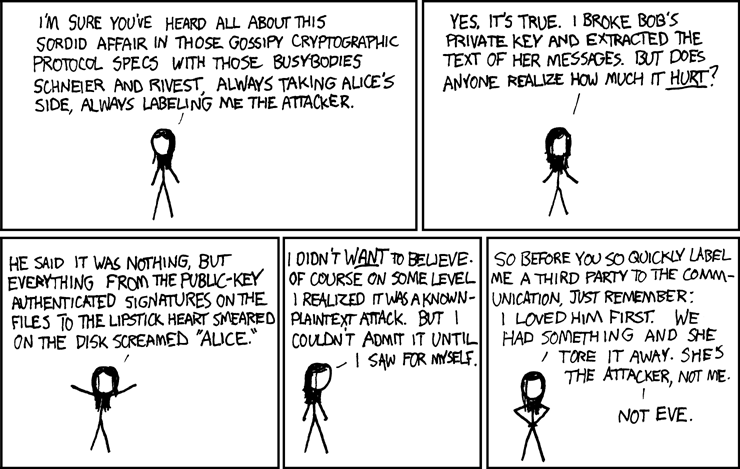
Girl: I’m sure you’ve heard all about this sordid affair in those gossipy cryptographic protocol specs with those busybodies Schneier and Rivest, always taking Alice’s side, always labeling me the attacker.
Girl: He said it was nothing, but everything from the public-key authenticated signatures on the files to the lipstick heart smeared on the disk screamed "Alice."
Girl: I didn’t want to believe. Of course on some level I realized it was a known-plain-text attack. But I couldn’t admit it until I saw it for myself.
Girl places her hands on her hips. Girl: So before you so quickly label me a third party to the communication, just remember: I loved him first. We had something and she tore it away. She’s the attacker, not me. - Not eve.