Section 0.3 Python
One of the components of this course is mathematical programming. The language chosen for this course is Python 3.
You can use Python on the central Linux server of UNCG. It is also installed on the computers in all ITS computer labs. You can download it for free at
http://www.python.org/download/.
There are several additional resources you may find helpful. Choose based on your programming background and desired difficulty level.
-
The Python 3 Tutorialdoes not attempt to be comprehensive and cover every single feature, or even every commonly used feature. Instead, it introduces many of Python’s most noteworthy features, and will give you a good idea of the language’s flavor and style. After reading it, you will be able to read and write Python modules and programs, and you will be ready to learn more about the various Python library modules described in The Python Standard Library.
1
docs.python.org/3/tutorial/This will be the main source of information for the programming assignments. In a typical semester, we cover most of the sections 1 through 5. -
The Non-Programmer’s Tutorial for Python 3is a tutorial designed to be an introduction to the Python programming language. This guide is for someone with no programming experience.
2
en.wikibooks.org/wiki/Non-Programmer's_Tutorial_for_Python_3 -
Python for Non-Programmersis aimed at readers with no previous programming experience. If you’ve never programmed before, the tutorials on this page are recommended for you.
3
wiki.python.org/moin/BeginnersGuide/NonProgrammers -
Python for Programmersis aimed at people who have previous experience with other programming languages (C, Perl, Lisp, Visual Basic, etc.).
4
wiki.python.org/moin/BeginnersGuide/Programmers -
The Python Wikiis a community place to gather and organize all things about Python. Feel free to exercise your editorial skills and expertise to make it a useful knowledge base and up-to-date reference on all Python-related topics.
5
wiki.python.org/moin/FrontPage -
Learn Python the Hard Wayinstructs you in Python by slowly building and establishing skills through techniques like practice and memorization, then applying them to increasingly difficult problems. By the end of the book you will have the tools needed to begin learning more complex programming topics.
6
learnpythonthehardway.org/book/
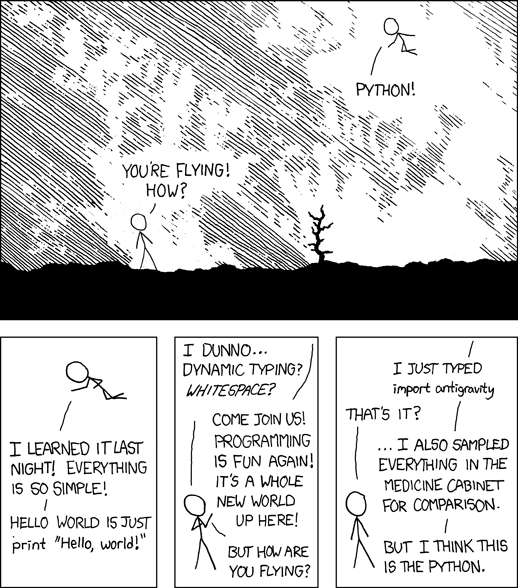
https://xkcd.com/353/) I wrote 20 short programs in Python yesterday. It was wonderful. Perl, I’m leaving you.
