Let \(p\) be a proposition. The negation of \(p\) , denoted \(\lnot p\) , is the proposition “It is not the case that \(p\text{.}\)” It is read as “Not \(p\)” and has the opposite truth value from \(p\text{.}\)
Let \(p\) be the proposition “\(2 + 3 = 5\)”. The negation \(\lnot p\) is the proposition “It is not the case that \(2 + 3 = 5\) .” More directly, \(\lnot p\) can be expressed as “\(2 + 3 \neq 5\) .” The original proposition \(p\) is true, so the negation is false.
Let \(q\) be the proposition “\(2^3 = 5\text{.}\)” The negation \(\lnot q\) is the proposition “It is not the case that \(2^3 = 5\) .” More directly, \(\lnot p\) can be expressed as “\(2^3 \neq 5\) .” The original proposition is false, so the negation is true.
Let \(p\) and \(q\) be propositions. The conjunction of \(p\) and \(q\text{,}\) denoted \(p\land q\) is the proposition “\(p\) and \(q\text{.}\)” It is true when \(p\) and \(q\) are both true and false otherwise.
The conjunction is often referred to as and . Figure 1.1.2.6 gives the truth table for conjunction. If \(p\) is true and \(q\) is true, then \(p\land q\) is true. If \(p\) or \(q\) are false (including the case where both \(p\) and \(q\) are false), then the conjunction \(p\land q\) is false.
Since \(p\) and \(q\) are both true, the conjunction \(p\land q\) is true. The conjunction \(p\land q\) can be expressed as “\(1 + 2 = 3\) and \(3 + 4 = 7\text{.}\)”
The conjunction \(p\land q\) is false because \(p\) is false. The fact that \(q\) is true is not enough to make the conjunction true. The conjunction \(p\land q \) can be expressed as “\(5 \lt 5\) and \(10 = 5 \cdot 2\text{.}\)”
The conjunction \(a\land b\) of \(a\) and \(b\) is the proposition “Alice is tall, and Bob is tall.” More directly, \(a\land b\) can be expressed as “Alice and Bob are tall.” The conjunction \(a\land b\) is true if Alice and Bob are both tall; it is false if either one is not tall.
Let \(p\) and \(q\) be propositions. The disjunction of \(p\) and \(q\text{,}\) denoted \(p\lor q\) , is the proposition “\(p\) or \(q\text{.}\)” It is false when \(p\) and \(q\) are both false and true otherwise.
The disjunction is often referred to as or . Figure 1.1.2.12 gives the truth table for disjunction. If at least one of \(p\) or \(q\) is true, then the disjunction \(p\lor q\) is true. If \(p\) and \(q\) are both false, then \(p\lor q\) is false.
The disjunction \(s\lor t\) of \(s\) and \(t\) is the proposition “Squares have four sides, or triangles have five sides.” The disjunction is true because squares have four sides. It does not matter that triangles don’t have five sides. Disjunctions are only false when both propositions being combined are false.
Let \(g\) be the proposition “I live in Greensboro,” and let \(j\) be the proposition “I was born in Japan.” Then \(g\) and \(j\) are both true. The disjunction \(g\lor j\) is true and can be expressed as “I live in Greensboro, or I was born in Japan.”.
Let \(s\) be the proposition “UNCG’s mascot is Rudy the Rodeo Clown,” and let \(m\) be the the proposition “The UNCG motto is Sleep.” The disjunction can be expressed as \(s\lor m =\) “UNCG’s mascot is Rudy the Rodeo Clown and motto is Sleep.” Since the mascot is Spiro the Spartan and the motto is Service, both \(s\) and \(m\) are false. Thus the disjunction \(s\lor m\) is also false.
Let \(p\) and \(q\) be propositions. The exclusive disjunction of \(p\) and \(q\text{,}\) denoted \(p\lxor q\) , is the proposition “\(p\) or \(q\) but not both.” It is true when exactly one of \(p\) or \(q\) is true and false otherwise.
The exclusive disjunction is \(o\lxor b\) is “An ostrich is a bird, or a beaver is a bird but not both.”. The exclusive disjunction is true, because an ostrich is a bird and a beaver is not a bird.
The exclusive disjunction of “Dogs are reptiles,” and “Snakes are mammals,” is “Dogs are reptiles or snakes are mammals, but not both.” The exclusive disjunction is false, because dogs are not reptiles, and snakes are not mammals. Exclusive disjunctions are true when exactly one of the propositions being combined is true.
The exclusive disjunction of “Dogs are mammals,” and “Snakes are reptiles,” is “Dogs are mammals or snakes are reptiles, but not both.” The exclusive disjunction is false, because dogs are mammals and snakes are reptiles. Exclusive disjunctions are true when exactly one of the propositions being combined is true.
Let \(p\) and \(q\) be propositions. The conditional of \(p\) and \(q\text{,}\) denoted \(p \implies q\) , is the proposition “if \(p\) then \(q\) .” It is false when \(p\) is true and \(q\) is false and true otherwise. In the conditional \(p \implies q\) , \(p\) is called the hypothesis and \(q\) is called the conclusion .
The conditional of “\(5^2 =10\)” and “\(3 \cdot 4 = 12\)” is “if \(5^2 =10\) , then \(3 \cdot 4 = 12\text{.}\)” The conditional is true because the the hypothesis is false. Similarly, the conditional “if \(5^2 =10\) , then \(3 \cdot 4 = 13\text{,}\)” is also true.
Let \(p\) and \(q\) be propositions. The biconditional of \(p\) and \(q\text{,}\) denoted \(p \iff q\) , is the proposition “\(p\) if and only if \(q\) .” In other words, \(p \iff q\) is the proposition \((p \implies q)\land (q \implies p)\text{.}\) It is true when \(p\) and \(q\) have the same truth values and false otherwise.
The biconditional “\(2 + 4 = 6\) if and only if \(2 \cdot 4 = 8\text{.}\)” is true because both component propositions are true. Biconditionals are true exactly when the component propositions have the same truth value.
The biconditional “\(2 + 4 = 7\) if and only if \(2 \cdot 4 = 9\)” is is true because both component propositions are false. Biconditionals are true exactly when the component propositions have the same truth value.
“Sharks have been spotted, but swimming is allowed,” can be written as \(q\land p\) . Note that “but” has been converted logically to “and” in this context. We will see more trickiness of the English language in Subsection 1.1.6.
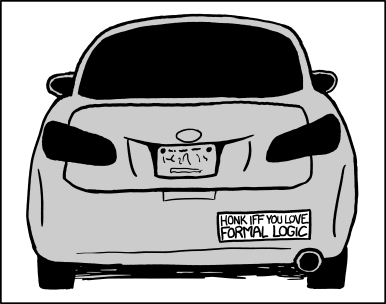
Figure1.1.2.32.Formal Logic by Randal Munroe (https://xkcd.com/1033/. Note that this implies you should NOT honk solely because I stopped for a pedestrian and you’re behind me.