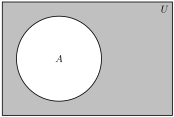
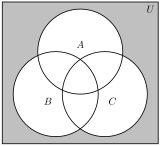
Let \(A = \set{1, 2, 3, 5, 10}\text{,}\) and let \(B = \set{2, 3, 4, 5}\text{.}\) Suppose \(U = \set{1, 2, \dots,10}\text{.}\) Then the complement of \(A\) consists of elements in \(U\) that are not in \(A\text{.}\) We can compute it by taking all of the elements of \(U\) and throwing out the elements of \(A\text{.}\) That gives
\begin{equation*}
\overline{A} =
\set{4, 6, 7, 8, 9}.
\end{equation*}
Analogously, the complement of \(B\) is consists of members of \(U\) that are not in \(B\text{,}\) so
\begin{equation*}
\overline{B} = \set{1,
6, 7, 8, 9, 10}.
\end{equation*}