
Discrete Mathematical Structures

Subsection 1.3.2 Universal quantification

Quantification expresses the extent to which a propositional function is true; for example, all, some, none, many, and so on.

Definition 1.3.2.1.

The universal quantification of \(P\) , denoted \(\forall x \, P(x)\) , is the proposition β€œ\(P(x)\) for all \(x\) in the domain.” The symbol \(\forall\) is the universal quantifier The domain of \(P\) specifies the possible values for \(x\) .
The domain of a propositional function matters. In ExampleΒ 1.3.2.2 and ExampleΒ 1.3.2.4 we consider propositional functions with the same predicate but with a different domain.

Example 1.3.2.2. For all integers.

Let \(S(x)\) be β€œ\(x \gt-2\)” with domain the integers. Consider the proposition
\begin{equation*} \forall x\, S(x) \end{equation*}
Because \(-5\) is an integer and β€œ\(-5\gt -2\)” is false \(\forall x\,S(x)\) is false.
The propositional function in the following example has the domain the natural numbers. We recall their definition:

Definition 1.3.2.3.

The natural numbers are the numbers:
\begin{equation*} 1, 2, 3, 4, 5, 6, \dots \end{equation*}

Example 1.3.2.4. For all natural numbers.

Let \(R(x)\) be β€œ\(x \gt-2\)” with domain the natural numbers. Consider the proposition
\begin{equation*} \forall x\, R(x) \end{equation*}
Because all natural numbers are positive and \(x\gt -2\) is true for all positive numbers we have that \(\forall x\, R(x)\) is true.

Remark 1.3.2.5.

The universal quantification of a propositional function is a proposition, since it is a declarative sentence that is either true or false, but not both.

Definition 1.3.2.6.

Let \(P(x)\) be a propositional function. A counterexample of \(\forall x \,P(x)\) is an element \(x_0\) such that \(P(x_0)\) is false.

Remark 1.3.2.7.

To prove a universal quantification is false, it suffices to exhibit a single counterexample.
In ExampleΒ 1.3.2.2 we haven given the counterexample \(x=-5\) to prove that the proposition β€œall integers are greater than \(-2\)” is false.

Example 1.3.2.8. Single counterexample.

Let \(P(x)\) be β€œ\(x^3\ge 0\)” with domain the integers. Then \(\forall x \,P(x)\) is false. To show this, it is enough to provide a single counterexample. Because \((-2)^3=8\) and β€œ\(-8 \gt 0\)” is false, so \(P(-2)\) is false. Thus \(\forall x \,P(x)\) is false.

Example 1.3.2.10. All dogs have brown fur.

Consider the statement β€œAll dogs have brown fur.” This universally quantified statement is false. My dog Duey provides a counterexample.
Let’s examine this in more detail. Let \(B(x)\) be β€œ\(x\) has brown fur,” with domain the set of all dogs. The universally quantified statement β€œAll dogs have brown fur,” can be written as \(\forall x \,B(x)\) . This is false, because we can produce a counterexample, namely my dog Duey. He is a dog, so he is in the domain of \(B\) . He does not have brown fur, so \(B(\text{Duey})\) is false. Thus \(\forall x \,B(x)\) is false. In other words, not all dogs have brown fur.
Example 1.3.2.12. Squares of integers are positive.

Let \(P(x)\) be β€œ\(x^2 \geq 0\)” with domain the integers. Then \(\forall x \,P(x)\) is true. To see this, fix a generic integer \(x\) . Then \(x^2\) is non-negative since the square of any real number is non-negative. Thus \(\forall x \,P(x)\) is true.

Proof.

Let \(a\) and \(b\) be integers. Starting on the left hand side of \(S(a,b)\) we get
\begin{align*} (a+b)(a-b)\amp = a(a-b)+b(a-b) \text{by the distirbutive law}\\ \amp=a^2-ab+ba-b^2\\ =a^2-b^2. \end{align*}
Thus \(S(a,b)\) is true for all integers \(a\) and \(b\text{.}\)
In the proof of TheoremΒ 1.3.2.15 we will apply the following result:

Proof.

We use a generic element to prove TheoremΒ 1.3.2.15.
  1. Let \(b\) be an integer.
  2. If \(b=0\) then \(b^2=a\cdot b=0\cdot 0=0\ge 0\) thus \(P(b)=P(0)\) is true.
If \(b\) is negative, by TheoremΒ 1.3.2.14, we have that \(b^2=b\cdot b\) is positive. Thus for negative \(b\) we have \(P(b)\) is true.
If \(b\) is positive, by TheoremΒ 1.3.2.14, we have that \(b^2=b\cdot b\) is positive. Thus for positive \(b\) we have \(P(b)\) is true.
Because each integer \(b\) is either equal to zero or negative or positive and \(b^2\ge 0\) in each of the three cases we have proven that \(b^2\ge 0\) for all integers \(b\text{.}\)
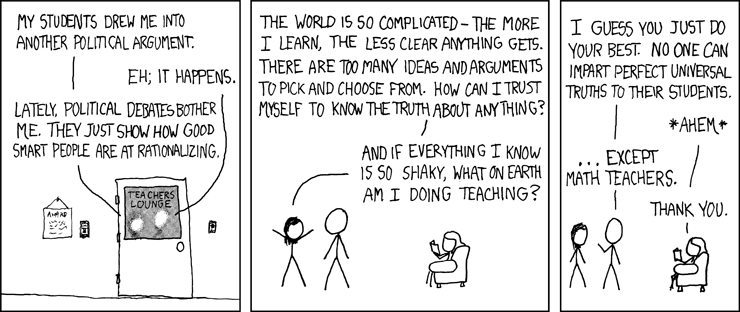
Figure 1.3.2.16. Certainty by Randal Muroe (https://xkcd.com/263/). \(a(b+c)=(ab)+ac\text{.}\) Polticize that bitches.

