
Discrete Mathematical Structures

Subsection 2.3.6 Bijective functions

Definition 2.3.6.1.

Let \(f \colon A \to B\text{.}\) The function \(f\) is bijective if \(f\) is injective and surjective (or one-to-one and onto). A bijective function is called a bijection or one-to-one correspondence.

Example 2.3.6.2. Identity function is bijective.

The identity function \(f \colon \RR \to \RR\) defined by \(f(x) = x\) is bijective.

Remark 2.3.6.4.

If \(A\) and \(B\) are finite sets of the same size, a function \(f \colon A \to B\) is surjective if and only if \(f\) is injective. Furthermore, if \(\size{A} \lt \size{B}\) then \(f\) cannot be surjective. If \(\size{B} \lt \size{A}\) then \(f\) cannot be injective.

Example 2.3.6.5. Area of a circle.

The area of a circle is a function of its radius. This function is injective, because if the area of a circle of radius \(r\) is equal to the area of a circle of radius \(r'\text{,}\) we must have \(r = r'\text{.}\) This function is not surjective, when viewed as a function from \(\RR_{> 0}\) to \(\RR\text{,}\) since there is no radius that would give rise to area \(-1\text{.}\) When we restrict the codomain to \(\RR_{>0}\text{,}\) this function is surjective since we can construct a circle for any given area.

Definition 2.3.6.7.

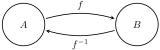
Let \(f \colon A \to B\) be a bijection. The inverse of \(f\text{,}\) denoted \(f^{-1}\) , is a function \(f^{-1} \colon B \to A\) that assigns to an element \(b \in B\text{,}\) the unique element \(a \in A\) such that \(f(a) = b\text{.}\)
From DefinitionΒ 2.3.6.7, it immediately follows that \(f\) is an invertible function if and only if
\begin{align*} f(f^{-1}(b)) \amp = b \quad \text{for all }b \in B; \text{ and} \\ f^{-1}(f(a)) \amp = a \quad \text{for all }a \in A. \end{align*}
Two sets A and B are represented each by an oval.  The ovals do not overlap. An arrow labeled f goes from A to B. An arrow labeled f to the -1 goes from B to A.
Figure 2.3.6.8. A function \(f\) from \(A\) to \(B\) and its inverse from \(B\) to \(A\text{.}\)

Example 2.3.6.10. Inverse of a function.

Consider the function \(f(x) = 3x + 2\text{.}\) Find the inverse of \(f\text{.}\)
Solution.
Let \(y = f(x)\text{.}\) Then \(f^{-1}(y) = x\text{.}\) That means we can just take \(y = 3 x + 2\text{,}\) and solve for \(x\text{.}\) Doing so, we see that \(x = \frac{y - 2}{3}\text{.}\) That means \(f^{-1}(y) = \frac{y - 2}{3}\text{.}\) Convention often dictates the input variable be named \(x\text{,}\) so we write it as
\begin{equation*} f^{-1}(x) = \frac{x - 2}{3}. \end{equation*}
Finding the inverse of a function is more difficult than checking if given functions are inverses of each other.

Example 2.3.6.11. Check the inverse.

Let \(f\) and \(g\) be functions from \(\RR\) to \(\RR\) given by \(f(x) = x^3 - 4\) and \(g(x) = \sqrt[3]{x + 4}\text{.}\) Determine whether \(g\) is the inverse of \(f\text{.}\)
Solution.
We need to check that and both hold. We compute each one separately. For all \(x \in \RR\text{,}\) we have
\begin{align*} f(g(x)) \amp = f(\sqrt[3]{x + 4}) \\ \amp = (\sqrt[3]{x + 4})^3 - 4 \\ \amp = (x + 4) - 4 \\ \amp = x; \end{align*}
\begin{align*} g(f(x)) \amp =g(x^3 - 4) \\ \amp = \sqrt[3]{(x^3 - 4) + 4} \\ \amp = \sqrt[3]{x^3 } \\ \amp = x. \end{align*}
Thus \(g\) is the inverse of \(f\text{.}\)
Note: This also shows that \(f\) is the inverse of \(g\text{.}\)
In ExampleΒ 2.3.6.12 observe how changing the plot of the graph of a function changes its graph and the properties of the function.

Example 2.3.6.12. Interactive plot of a function with invertibility.
