A proposition is a declarative statement (a statement that declares a fact) that is either true or false but not both. The truth value of a proposition is often denoted \(\true\) for true and \(\false\) for false.
This is a declarative statement, but it is not a proposition. This is more subtle. Suppose the statement is true. The statement is asserting it is false. The only way for that to be true would be for the statement to be false. In that case, the assertion that it is false would be true\dots. This sort of self-referential statement that does not allow for a single truth value is not a proposition.
The last example is a bit more subtle. Here, the statement is not a proposition because there are variables in the statement that are not quantified. We will see how to deal with such things in detail in Subsection 1.3.1.
This is a declarative statement, but it is not a proposition. Why? The truthfulness of the sentence depends on the value of the variable \(x\) , so it does not have a well-defined truth value. For example, it is true when \(x = 2\) , but it is false when \(x = 3\) . This sort of ambiguous statement is not a proposition.
Consider the statement “Bob is taller than Alice.” This is a proposition since it is a declarative statement that is either true or false, but not both. It does not bother us that we don’t know if it is true or false. The statement is a proposition because it declares a fact that is either true or false.
We will often use propositional variables to represent propositions. For example, let \(p =\) “2 + 3 = 5,” and let \(q\) be “My name is Dan.” In this case, the proposition \(p\) is true. We also have that the proposition \(q\) is true, provided we agree on the convention that first person pronouns refer to me, the author.
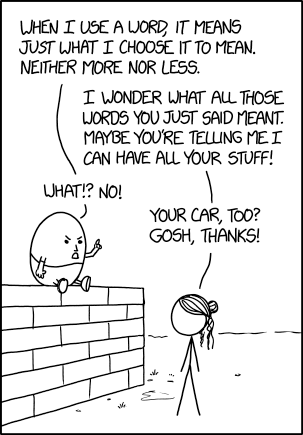
Figure1.1.1.10.Communicating by Randal Munroe (https://xkcd.com/1860/). You’re saying that the responsibility for avoiding miscommunication lies entirely with the listener, not the speaker, which explains why you haven’t been able to convince anyone to help you down from that wall.