
Discrete Mathematical Structures

Subsection 1.4.4 Proof by contradiction

Let \(s\) and \(r\) be propositions. Recall that \(r\land\lnot r\) is a contradiction. In particular, \(r\land\lnot r\) is always false. If we can prove that \(\lnot s\implies (r\land\lnot r)\) is true, then \(\lnot s\) must be false. In this case, \(s\) must be true.
Unwinding that, we get a technique known as proof by contradiction . Namely, we can prove \(s\) is true by producing a direct proof of \(\lnot s \implies (r\land\lnot r)\text{.}\) That is, to prove \(s\) is true, we start by assuming \(\lnot s\) is true and try to reach a contradiction.
For the next example we need the following definition.

Definition 1.4.4.2.

A number \(r\) is rational if there exists integers \(p\) and \(q\) with \(q \neq 0\) such that \(r = \frac{p}{q}\text{.}\)
We say that a rational number \(\frac{p}{q}\) is written in lowest terms when there exists no integer \(d\) with \(d>1\text{,}\) \(d\ne p\text{,}\) and \(d\ne q\) and no integers \(k\) and \(l\) such that \(p=d\cdot k\) and \(q=d\cdot l\text{.}\)
A number that is not rational is called irrational.

Example 1.4.4.3. The square root of two is irrational.

Prove that \(\sqrt{2}\) is irrational.
Answer.
We proceed by contradiction. Suppose \(\sqrt{2}\) is rational. Then there exists integers \(p\) and \(q\) , with \(q \neq 0\) such that \(\sqrt{2} = \frac{p}{q}\text{.}\) Note that we can arrange that the fraction is in lowest terms by canceling common factors, so without loss of generality assume that \(p\) and \(q\) have no common factors.
Squaring both sides of \(\sqrt{2} = \frac{p}{q}\) yields \(2 = \frac{p^2}{q^2}\text{.}\)
Multiplying both sides by \(q^2\) we get \(2q^2 = p^2\text{.}\) Because \(q^2\) is an integer this means that \(p^2\) is even. It follows with ExampleΒ 1.4.3.2 that \(p\) is even. So there exists an integer \(k\) such that \(p =2k\text{.}\)
With \(p=2k\) we get \(2q^2 = (2k)^2 = 4k^2\text{.}\) Dividing by \(2\text{,}\) we obtain \(q^2 =2k^2\) which implies that \(q^2\) is even. Again, it follows with ExampleΒ 1.4.3.2 that \(q\) is even.
From our assumption that \(\sqrt{2}\) is a rational number we have deduced that \(p\) and \(q\) must be even. This contradicts our assumption that \(p\) and \(q\) have no common factor.
Thus \(\sqrt{2}\) cannot be a rational number, which means that \(\sqrt{2}\) is irrational.
Example 1.4.4.4. No rational number.

Use a proof by contradiction to show that there is no rational number \(r\) for which \(r^3 + r + 1 = 0\text{.}\)
Answer.
Suppose there is a rational number \(r = \frac{a}{b}\) such that \(r^3 + r + 1 = 0\) , where we write \(\frac{a}{b}\) is lowest terms so that \(a\) and \(b\) have no common factors. Then
\begin{equation*} \left(\frac{a}{b}\right)^3 + \frac{a}{b} + 1 = 0. \end{equation*}
Multiplying both sides by \(b^3\) , we get
\begin{equation*} a^3 + ab^2 + b^3 = 0. \end{equation*}
There are four cases to consider, depending on the parity (even/odd) of \(a\) and \(b\text{.}\)
\(a\) and \(b\) both even
This case contradicts that \(\frac{a}{b}\) is in lowest terms, because they have the common factor \(2\text{.}\)
\(a\) and \(b\) both odd
Then \(a^3\text{,}\) \(ab^2\text{,}\) and \(b^3\) are all odd. The sum of three odd numbers is odd and thus cannot be equal to \(0\) which is even.
\(a\) is even \(b\) is odd
Then \(a^3\) and \(ab^2\) are even, and \(b^3\) is odd. The sum of two even integers and an odd integer is odd thus cannot be equal to \(0\) which is even.
\(a\) is odd \(b\) is even
Then \(a^3\) is odd, and \(ab^2\) and \(b^3\) are even. The sum of an odd integer and two even integers is odd thus cannot be equal to \(0\) which is even.
Since all four cases yield a contradiction, there is not rational number \(r\) such that \(r^3 + r + 1 = 0\text{.}\)
We give an alternative proof of the result from ExampleΒ 1.4.0.18.

Example 1.4.4.5. If \(x^2+2x+1\) is odd then \(x\) is even by contradiction.

Prove by contradiction that if for an integer \(x\) we have \(x^2+2x+1\) is odd then \(x\) is even.
Answer.
We assume that \(x^2+2x+1\) is even then \(x\) is even and show that this leads to a contradiction.
As \(x\) is even by DefinitionΒ 1.4.1.1 there exists an integer \(k\) such that \(x=2k\text{.}\) Then
\begin{equation*} x^2+2x+1=(2k)^2+2(2k)+1=4k^2+4k+1=2(2k^2+2k)+1. \end{equation*}
Because \(2k^2+2k\) is the sum of products of integers it is an integer. Thus by DefinitionΒ 1.4.1.5 we have that \(x^2+2x+1\) is odd. This contradicts our assumption that \(x^2+2x+1\) is even. So \(x^2+2x+1\) must be odd which concludes our proof.
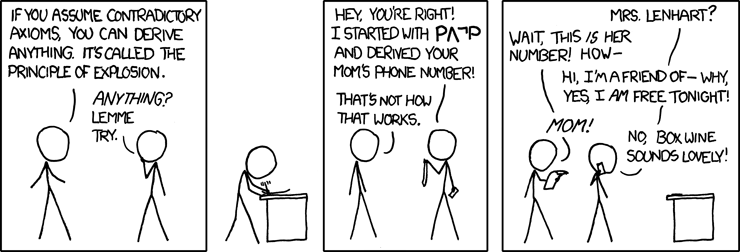
Figure 1.4.4.6. Principle of Explosion by Randal Munroe (https://xkcd.com/704/). You want me to pick up waffle cones? Oh, right, for the wine. One sec, let me just derive your son’s credit card number and I’ll be on my way.

