In our discussions of sets and set operations the domain of all propositional functions and thus for all quantification will be the universal set, unless specified explicitly.
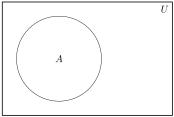
Figure2.1.1.3.The box in the Venn diagram represents the universal set \(U\) that contains all objects under consideration. Other sets, like the set \(A\) pictured, are represented by circles or ovals inside this box.
By the convention stated above \(\forall x (x \in A \iff x \in B)\) is read
“For all elements \(x\) of the universal set we have that \(x\) is an element of the set \(A\) if and only if \(x\) is an element of the set \(B\text{.}\)”
We specify a set in roster form by listing the elements explicitly between braces, for example, \(\set{1, 2, 7}\text{.}\) To indicate that the list of continues in a pattern that can be deduced from the preceding list of elements we use ellipsis (\(\ldots\)), for example
No. Sets are like bags. A bag with an apple in it is different from an apple. The set \(\set{3}\) is a set with one element \(3\) in it. The number \(3\) is not the same as the set containing just \(3\text{.}\)
We denote the set of real numbers by \(\RR\text{.}\) , For our purposes, the intuitive idea that they are all numbers that can be written in finite or infinite decimal representation is sufficient.
We have special notation for intervals of real numbers.
\begin{align*}
[a,b] \amp = \set{x \given x \in \RR, a\leq x\leq b } \\
(a,b] \amp = \set{x \given x \in \RR, a \lt x\leq b } \\
[a,b) \amp = \set{x \given x \in \RR, a\leq x \lt b } \\
(a,b) \amp = \set{x \given x \in \RR, a \lt x \lt b }
\end{align*}
We have \(A = B\text{,}\) because for every element \(x\text{,}\) the truth value of \(x \in A\) is the same as the truth value of \(x \in B\text{.}\) Thus \(A = B\) by definition.
To show two sets are equal, we use subsets as described later in Proof Technique Proof Technique 2.1.2.7. It is more straightforward to show two sets are not equal. Since set equality is defined as the universal quantification (“for all”) of a biconditional (“if and only if”), to show two sets are not equal, it is enough to find any counterexample to the biconditional. In particular, we just need to produce any element that they do not share.
Suppose \(A\) and \(B\) are sets, and we want to prove \(A\) is not equal to \(B\text{.}\)
Find a particular element \(a\) in \(A\) that is not a member of \(B\text{;}\) or find a particular element \(b\) in \(B\) that is not a member of \(A\text{.}\)