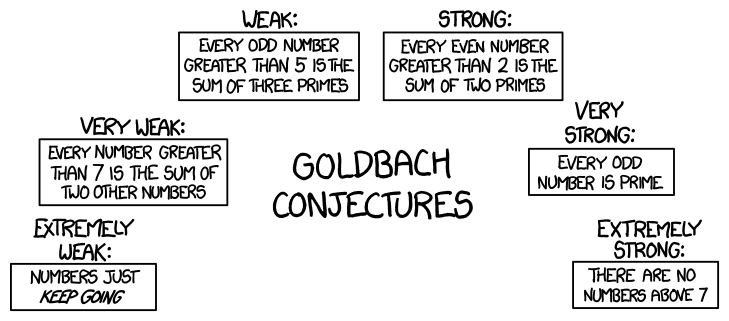
Another famous open problem in number theory concerns decomposing integers into sums of primes. In a letter to Leonhard Euler in 1742, Christian Goldbach conjectured that every odd integer \(n\text{,}\)\(n \gt 5\text{,}\) is the sum of three primes. Euler replied that this conjecture is equivalent to the conjecture that every even integer \(n\text{,}\)\(n>2\text{,}\) is the sum of two primes. For example, \(4 = 2 + 2\text{,}\)\(6 = 3 + 3\text{,}\)\(8 = 3 + 5\text{,}\)\(10 = 3 + 7\text{,}\) and so on.
Although no proof of the Goldbach conjecture has been found, the conjecture has been computationally checked to hold up to \(4 \cdot 10^{18}\text{,}\) see [4].
Figure5.3.2.5.Goldbach Conjectures ({https://xkcd.com/1310/}) The weak twin primes conjecture states that there are infinitely many pairs of primes. The strong twin primes conjecture states that every prime \(p\) has a twin prime \((p+2)\text{,}\) although \((p+2)\) may not look prime at first. The tautological prime conjecture states that the tautological prime conjecture is true.