We can answer this question by starting with \(a\) and repeatedly subtracting \(b\) until we obtain a number less than \(b\text{.}\) We call the number of times \(q\) that we have subtracted \(b\) the quotient of the division of \(a\) by \(b\) and the value \(r\) with \(0\le r\lt b\) that is left over the remainder. We get
\begin{equation*}
a\underbrace{-b-b-\ldots-b}_{q \text{ copies of }b}=a-q\cdot b=r\lt b.
\end{equation*}
If we rearrange this we get:
\begin{equation*}
a=\underbrace{b+b+\ldots+b}_{q \text{ copies of }b}+r=q\cdot b+r.
\end{equation*}
The above proves a theorem called Division Algorithm for non-negative integers, see Theorem 5.1.1.9 for the general version.
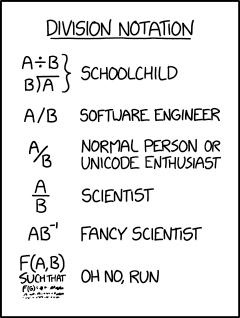
Figure0.1.5.2.Division Notation. (https://xkcd.com/2687) Science tip: Scientists hardly ever use the two-dot division sign, and when they do it often doesn’t even mean division, but they still get REALLY mad when you repurpose it to write stuff like SALE! ALL SHOES 30÷ OFF!