
Discrete Mathematical Structures

Subsection 1.1.6 English is hard

The English language is tricky and subtle. There are many ways to say the same thing, and there are many preconceptions that people have that must be let go when studying logic. In this section, we give lots of examples and highlight some of the common misconceptions.

Example 1.1.6.1. Happy in the rain.

Let \(p\) be the proposition β€œIt is raining,” and let \(q\) be the proposition β€œI am happy.” Then the following are some of the correct ways to express \(p\land q\) .
For propositions \(p\) and \(q\text{,}\) the following are correct ways to express \(p \implies q\) .
Note that β€œ\(p\) only if \(q\)” says that \(p\) cannot be true when \(q\) is not true. Similarly, β€œ\(q\) unless \(\lnot p\)” says that if \(\lnot p\) is false, then \(q\) must be true. Looking at the truth tables, we see that they are restatements of if \(p\) , then \(q\text{.}\)

Warning 1.1.6.2.

Conditionals are independent of cause and effect. The hypothesis and conclusion may not be related. There is no implied cause and effect or any other type of relationship between the statements in a true conditional proposition.

Example 1.1.6.3. Conditional and causation.

β€œIf the sun comes up in the morning, then \(2 + 2 = 4\) .” This conditional is true since the hypothesis and conclusion are true. The conditional does not say anything about causation.
Let’s look at some English conditionals. We will rewrite them in the β€œif \(p\) then \(q\)” form to make them easier to analyze. Recall the truth table for \(p \implies q\) :
\begin{equation*} \begin{array}{|*{2}{c|}|*{1}{c|}} \hline p\amp q\amp p \implies q\\ \hline \true\amp \true\amp \true\\ \true\amp \false\amp \false\\ \false\amp \true\amp \true\\ \false\amp \false\amp \true\\ \hline \end{array} \end{equation*}

Example 1.1.6.4. Pass the course with effort.

Consider the proposition β€œYou will pass this course only if you put in the effort.” Recall the conditional \(p \implies q\) can be phrased as β€œ\(p\) only if \(q\text{.}\)” We can rewrite this as β€œIf you pass this course, then you must have put in the effort.”
Note: It is possible that you fail this course, even if you put in the effort. This conditional says that if you pass this course, then we can deduce that you put in the effort.

Example 1.1.6.5. Pass the course unless.

Consider the proposition β€œYou will pass this course unless you don’t put in the effort.” Recall the conditional \(p\implies q\) can be phrased β€œ\(q\) unless not \(p\text{.}\)” Thus we can rewrite the given proposition as β€œIf you put in the effort, then you will pass this course.” Note: It is possible to pass the course even if you do not put in the effort, but if you put in the effort, we can deduce that you will pass this course.

Example 1.1.6.6. Wash the boss’s car.

Consider the proposition β€œIt is necessary to wash the boss’s car to get promoted.”
Recall that the conditional \(p\implies q\) can be phrased as β€œ\(q\) is necessary for \(p\)”. Namely, in order for \(p\) to be true, \(q\) must be true. The given proposition is that washing the car is necessary for the promotion. We can rephrase that as β€œIf you get promoted, then you must have washed the boss’s car.”
A useful way to think of these things is in terms of an obligation or contract. Note: This proposition makes no claims about what will happen if you wash the boss’s car. Specifically, if you wash the boss’s car, you should not expect to be promoted because of that.

Example 1.1.6.7. Roller coaster.

Express the following sentence symbolically:
β€œYou cannot ride the roller coaster if you are under 4 feet tall unless you are older than 16 years old.”
Let \(r\) , \(f\text{,}\) and \(s\) be the propositions
  1. \(r \) is β€œYou can ride the roller coaster,”
  2. \(f \) is β€œYou are under 4 feet tall,”
  3. \(s \) is β€œYou are older than 16 years old.”
Then we the sentence can be expressed symbolically as
\begin{equation*} \lnot s \implies (f \implies\lnot r). \end{equation*}
Can you convince yourself that the statement can also be expressed as
\begin{equation*} (f\land\lnot s) \implies\lnot r? \end{equation*}
We will see how to reconcile this in SectionΒ 1.2.

Example 1.1.6.8. Truth-tellers and liars.

An island has two tribes, truth-tellers and liars. You encounter two people, Alice and Bob, on the island. Alice says β€œBob is a truth-teller,” and Bob says, β€œWe are from different tribes.” Let’s figure out who is from which tribe.
Let \(a\) be the proposition β€œAlice is a truth-teller,” and let \(b\) be β€œBob is a truth-teller.”.
Then Alice’s statement is \(b\) . Bob’s statement is that \(a\) and \(b\) have opposite truth values, so his statement is \(a \iff\lnot b\) . Note that Alice’s statement must have the same truth value as \(a\) because her statement is true if and only if she is a truth-teller. That means \(a \iff b\) must be true. Analogously, Bob’s statement has the same truth value as \(b\) , so \((a\iff\lnot b) \iff b\) must be true.
Let’s work out the truth table. We are looking for a row where \(a\iff b\) and \((a \iff\lnot b) \iff b\) are both true.
\begin{equation*} \begin{array}{|*{2}{c|}|*{4}{c|}} \hline a\amp b \amp \lnot b \amp a \iff\lnot b \amp a \iff b \amp (a \iff\lnot b) \iff b \\ \hline \true\amp \true\amp \false \amp \false \amp \true\amp \false \\ \true\amp \false \amp \true\amp \true\amp \false \amp \false \\ \false \amp \true\amp \false \amp \true\amp \false \amp \true\\ \false \amp \false \amp \true\amp \false \amp \true\amp \true\\ \hline \end{array} \end{equation*}
From the last two columns, we see that \(b \iff a\) and \((a\iff\lnot b) \iff b\) are both true in the row where \(a\) and \(b\) are false. In other words, we have that Alice and Bob are both liars.
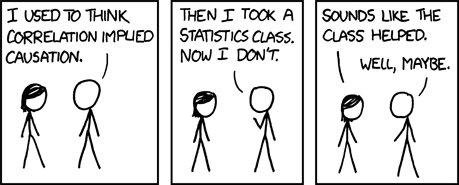
Figure 1.1.6.9. Correlation by Randal Munroe (https://xkcd.com/552/). Correlation doesn’t imply causation, but it does waggle its eyebrows suggestively and gesture furtively while mouthing `look over there’.

